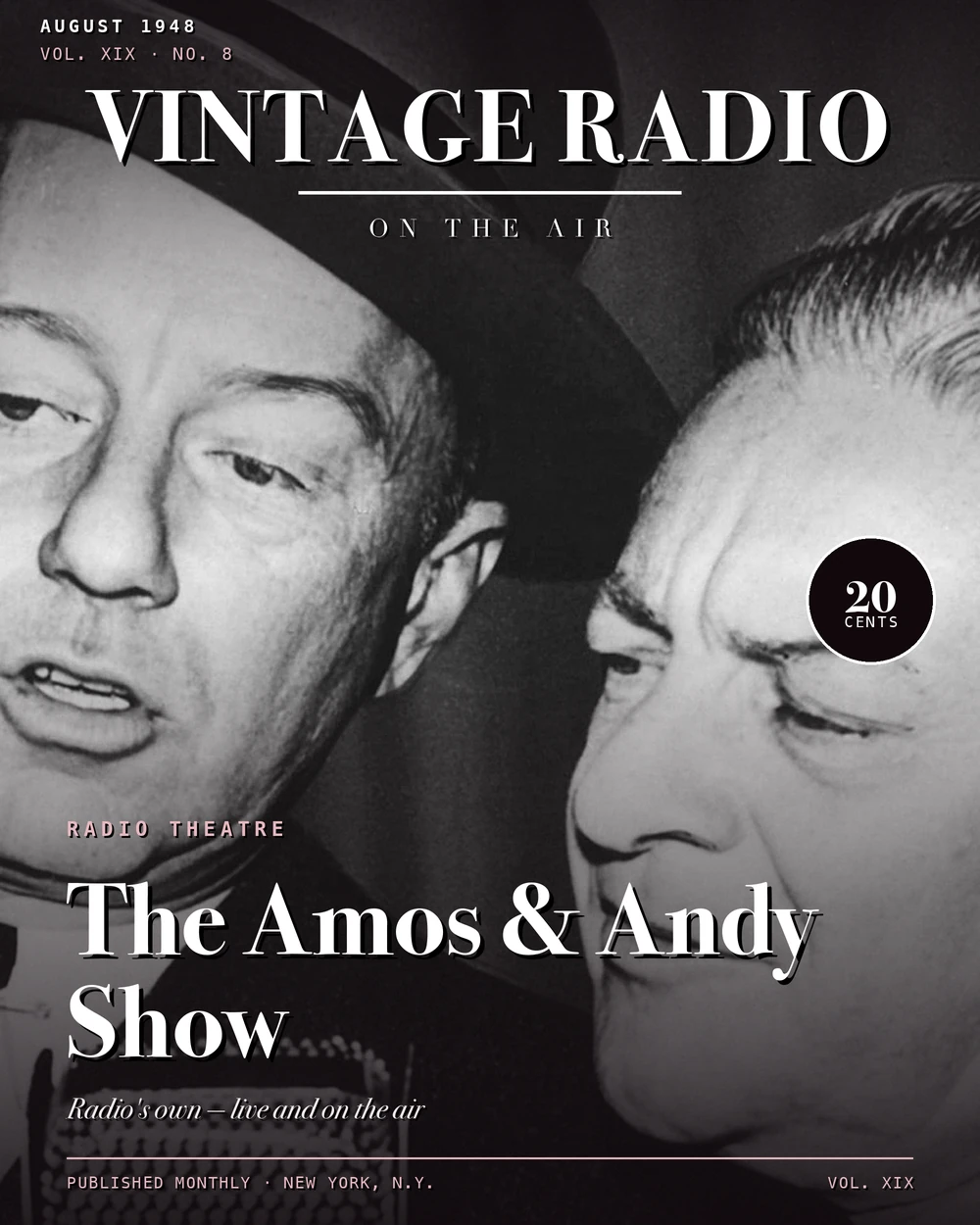
The Amos & Andy Show
The Show That Stopped America
There is one reliable measure of how completely a radio program can grip a nation, and the Amos & Andy Show hit it in the early 1930s: sanitary engineers in major cities noticed that sewer pipe flow dropped between 7 and 7:15 p.m. every weeknight and then surged the moment the broadcast ended. Authors Bart Andrews and Ahrgus Juilliard documented the phenomenon in their biography of the show, Holy Mackerel, and it stands as probably the most unglamorous tribute in broadcasting history. Every radio in the country was tuned to the same fifteen minutes. Nobody was moving.
The show's peak ratings confirm what the pipes suggested. In 1931, the CAB rating crested at 53.4 — an audience share that has rarely been approached in any broadcast medium before or since, and Andrews and Juilliard cite moments when the show captured 74% of the national radio audience. During the episode in which Amos was arrested and charged with murder, the listening audience was estimated at 40 million people, very close to one-third of the entire American population at the time. Movie theater marquees announced that films would be stopped at 7 p.m. so audiences would not miss the broadcast. Some theaters piped the show directly into their screening rooms. Newspapers ran daily summaries of the serial's progress, treating the fiction of two fictional Black men from Atlanta navigating life in Chicago as straightforwardly as they reported the news. The show had debuted coast-to-coast on NBC's Pacific Orange Network on November 28, 1929, after Western listeners complained they couldn't pick it up on the Blue Network, and by 1930 NBC's standing order was to interrupt the broadcast only for matters of national importance and SOS calls. When Amos and Ruby's newborn daughter needed a name, 2.4 million fans wrote in with suggestions.
The show is generally considered the first great radio program and the first significant radio serial. That isn't a casual claim. It simply means that nothing else on American radio before it had demonstrated, at this scale, what the medium could do when a story was told night after night in real time, with characters audiences genuinely cared about. George Bernard Shaw put it in typically quotable form: "There are three things I'll never forget about America — the Rocky Mountains, Niagara Falls, and Amos 'n' Andy." Listeners included Presidents Calvin Coolidge and Herbert Hoover, and Freeman Gosden and Charles Correll were guests at the White House. By 1931, they were described, alongside Will Rogers, as "public gods."
How Gosden and Correll Built It From Scratch
Freeman Gosden was born May 5, 1899, in Richmond, Virginia, into a family with Confederate ties. Before radio, he sold cars and tobacco and served as a Navy radio operator during World War I. Charles Correll was born in Peoria, Illinois, on February 2, 1890, and worked as a stenographer and a bricklayer while trying to break into show business. The two met around 1919 when they both went to work for the Joe Bren Producing Company, which organized theatrical productions for charitable and amateur groups. Correll had signed on in Peoria and was sent to Durham, North Carolina, where he encountered Gosden. By 1924, they were based together in Chicago managing a circus division for Bren and rooming together in an apartment where they filled spare time singing harmony — Gosden on ukulele, Correll at the piano.
They began billing themselves as the Life of the Party and taking paid engagements. A friend suggested radio. One appearance on WQGA led to an audition at WEBH, a small station operating out of a studio off the dining room of the Edgewater Beach Hotel. WEBH couldn't pay cash, only meals, so Gosden and Correll performed a six-nights-a-week songfest at 11:30 p.m. in exchange for dinner. That was enough to convince them to quit their day jobs entirely.
WGN, owned by the Chicago Tribune, offered them $250 a week. The station wanted them to develop what was called a "strip show" — five weekly installments structured like an audio comic strip. The Tribune pushed for something based on one of its own strips, but Gosden and Correll drew instead on their familiarity with Negro dialect voices and built their own characters: Sam Smith and Henry Johnson, two men from Birmingham who had come north to seek their fortune. Sam 'n' Henry debuted on WGN on January 12, 1926, and ran for 586 episodes over two years. Ratings started slowly, then climbed steadily after Gosden and Correll signed a two-year contract extension at $300 a week.
The end of that contract produced the pivot point. WGN owned the show and the characters' names outright, and when Gosden and Correll asked to record episodes for syndication in other markets, the station refused. They walked after the broadcast of December 18, 1927. At WMAQ, their new Chicago home, they were free to record, and they cut their episodes onto 78-rpm discs at Marsh Laboratories, run by the electrical recording pioneer Orlando R. Marsh. The relaunched show — now called Amos 'n' Andy, with the characters relocated from Birmingham to Atlanta — began reaching stations around the country, building a national audience before the show ever touched a network. Gosden and Correll called their idea a "chainless chain" and tried unsuccessfully to patent it; by the end of the syndicated run in August 1929, at least 70 stations were carrying recorded episodes, and when NBC picked the show up on August 19, 1929, those syndicated transcriptions had already outperformed NBC programming in many of the markets where they played. The chainless chain became the basis for the broadcast syndication industry that followed.
Two Men, Every Voice, One Empty Studio
The mechanics of how Gosden and Correll actually made the show are worth understanding in detail, because they explain much of what made it work. In the early years, the two men played every single character — over 170 male voice characterizations across the nightly run of the first decade. Gosden took Amos Jones — high-pitched, earnest, the moral center — and stood about two feet from the microphone. Correll took Andrew H. Brown — deep-voiced, slow-thinking, perpetually scheming — and leaned to within an inch of the microphone. Gosden also played the Kingfish from yet another microphone position, and a young boy named Sylvester from still another, very close position. In complicated scenes — the Amos murder trial ran to courtroom sequences requiring rapid-fire voice changes — they used as many as ten distinct voices between them.
They broadcast alone in an otherwise empty studio, seated at a table. They never looked at each other during broadcasts, because eye contact was likely to break them into laughter. On at least one occasion, Gosden had to douse himself with a glass of water to keep from laughing on the air. Announcer Bill Hay reported that after particularly engrossing sketches, both men often left the studio with tears in their eyes.
Their writing process was equally improvised. Gosden would pace the room, flipping coins from hand to hand, dictating the script out loud while Correll used his stenography skills to transcribe and later type it up. Scripts were often completed just before air time. They performed with no rehearsal, convinced that spontaneity was part of what made the show feel alive. A premium book titled All About Amos 'n' Andy noted that "the boys are in character every minute they are on the air" — props including pencils, cigarettes, cigars, dishes, glasses, and food were actually used during the broadcasts to keep the performance grounded.
Female characters presented a particular technical constraint in the early years. No women were heard on the early broadcasts at all. Characters like Ruby Taylor and the Widow Parker existed entirely through being talked about and through one-sided telephone conversations — the audience heard Amos or Andy speaking but never the woman on the other end of the line. It was a limitation the writing turned into a craft: those absent characters became, through description and reaction alone, fully realized people. Actresses began voicing female characters in 1935; prior to 1931, a feminine voice had been heard exactly once, when Madame Queen took the witness stand in her breach-of-promise lawsuit against Andy.
The Characters and Their World
The fictional setting Gosden and Correll built was specific and lived-in. Amos and Andy had come up from Atlanta with four ham-and-cheese sandwiches and $24 between them, settled in a State Street rooming house, and scraped together $25 to buy a broken-down car — one with no windshield — and founded the Fresh Air Taxi Company, "Incopolated." The name came from the missing windshield, and the company's perpetual struggles drove storyline after storyline.
The Kingfish — George Stevens, conniving head of the Mystic Knights of the Sea lodge — was introduced on May 25, 1928, while the show was still on WMAQ, and quickly became the show's most beloved comic engine. The lodge hall itself was populated with members known only by their lodge titles: the Shad, the Mackerel, the Whale, the Swordfish. The Kingfish's wife was initially referred to on the show only as "the Battleaxe" before eventually being named Sapphire and given a full character of her own. The Widow Parker — nicknamed "Snookems" by Andy and described as "practiced in the arts of love and a graduate of five marriages" — became the center of a long-running breach of promise storyline that ended when she spotted her supposedly dead husband in the courtroom crowd.
The murder trial storyline, which drew that 40 million listener estimate, resolved with a device that might frustrate modern audiences: Amos woke up and the entire sequence turned out to be a dream. The "Andy's wedding" storyline ended differently — and more dramatically. It climaxed on May 3, 1939: at the exact moment Andy was to say "I do," a shot rang out and he fell wounded, leaving listeners uncertain whether the marriage had even legally occurred. By that point, however, the show had slipped to 60th place in the ratings. The wedding episode was a genuine piece of serial craft deployed at a moment when the audience had largely moved on.
The show's catchphrases became part of everyday American speech: "Tse regusted," "Ya doan mean tuh tell me," "Ain't dat sumpin'," and "I ain't-a-gonna-do-it." By 1929, Louisiana politician Huey P. Long had acquired the nickname "the Kingfish" directly from Gosden's character. That kind of cultural seepage — a fictional radio character's nickname attaching itself permanently to a real-world political figure — is a measure of how deeply the show had worked its way into the national conversation.
Beyond the Microphone: Film and Animation
The popularity inevitably spilled into other media. By 1930, the toy maker Louis Marx and Company was selling a tin wind-up Fresh Air Taxi with Amos and Andy inside; a special autographed version was sent as gifts to American leaders including President Hoover. A daily comic strip ran in syndication via the Chicago Daily Press. RKO put Gosden and Correll into a 1930 feature, Check and Double Check, directed by Melville W. Brown from a screenplay by Bert Kalmar, J. Walter Ruben, and Harry Ruby, featuring Duke Ellington and his Cotton Club Orchestra and introducing the Kalmar–Ruby standard "Three Little Words." The film earned RKO a $260,000 profit, but Gosden himself reportedly called it "just about the worst movie ever," and the studio concluded audiences had come out of curiosity rather than appetite for more. RKO did release two animated shorts produced by the Van Beuren Corporation in 1934 — The Rasslin' Match and The Lion Tamer — with Gosden and Correll recording their own dialect voices for the soundtracks. The projected animated series ended after those two films. Gosden and Correll also turned up briefly as Amos and Andy in The Big Broadcast of 1936.
The Reinvention and the Recovery
By 1943, the numbers told a clear story. The CAB rating that had stood at 53.4 in 1931 had fallen to 22.6 by 1935, 11.6 by 1940, and 9.4 by 1943. The fifteen-minute serial format that had made the show had also, over seventeen years and 4,091 episodes, run it thin. The decision made that October was a significant one: the show was retooled as a half-hour situation comedy with a full cast, a new announcer, an orchestra, and — for the first time in its history — a studio audience. Gosden and Correll brought in head writers and producers Joe Connelly and Bob Mosher, two former J. Walter Thompson copywriters who would eventually earn credits on more than 1,500 Amos 'n' Andy scripts before going on to create Leave It to Beaver and The Munsters.
The supporting cast that arrived in 1943 and the years just after was substantial. Ernestine Wade played Sapphire; Amanda Randolph played Mamma, the Kingfish's mother-in-law; Harriette Widmer played Madame Queen, Andy's most notorious romantic interest; Elinor Harriot played Ruby Taylor; Terry Howard played Amos's daughter Arbadella; Madeline Lee played Miss Genevieve Blue, the secretary at the Fresh Air Taxi Company (Andy's "Buzz me, Miz Blue" became a recurring catchphrase); and Lou Lubin played Shorty the Barber, a stuttering character who always ended his long speeches with a one- or two-word summary, often the opposite of what he'd been trying to say. James Baskett joined in 1944 as the fast-talking lawyer Gabby Gibson and became nationally known in the role before winning an Honorary Academy Award for his portrayal of Uncle Remus in Disney's Song of the South. When Baskett's health declined and he missed nearly half of the 1947–48 season, Eddie Green stepped in — a Baltimore-born performer who had spent eleven years with Billy Minsky's Burlesque before his radio career. Green played a crooked lawyer named Stonewall; his line deliveries were particularly sharp, as when Andy once asked whether Stonewall was trying to get him to do something mean and crooked, and Stonewall replied without pause: "Oh, man, yeah!" Green died of a heart ailment in September 1950, and Johnny Lee took over a new lawyer character, the conniving Algonquin J. Calhoun.
The broader Black supporting roster was unusual in mainstream radio of the era. Ruby Dandridge and Dorothy Dandridge appeared on the show, as did Jester Hairston, Roy Glenn, William Walker, and "Wonderful" Smith — many of them in roles that didn't conform to the stereotype the radio show was often accused of trafficking in. By the 1940s and 1950s, the program had become the single most important source of employment for Black actors in network radio.
The half-hour sitcom version immediately doubled the 1942 rating, jumping from 9.4 to 17.1 and eventually reaching into the low twenties. One episode became an annual tradition that listeners returned to every year: Arbadella wanted a doll for Christmas; Andy took a job as a department store Santa to earn the money; in the closing sequence Amos explained the true meaning of Christmas while the chorus sang the Lord's Prayer. It was a piece of holiday radio that worked on its own terms.
Bill Hay, who had been the show's announcer since the WGN days — fifteen years in all — was let go in 1943. His departure was described at the time as heartbreaking for him. The organist Gaylord Carter, who had played throughout the serial years, was replaced by Lud Gluskin's band and later by Jeff Alexander's orchestra and chorus, with vocal group the Jubilaires — Theodore Brooks, John Jennings, George MacFadden, and Caleb Ginyard — performing regularly.
In 1948, CBS chairman William S. Paley executed his famous raid on NBC's comedy roster, offering talent deals that included significant tax advantages. Amos & Andy was among the shows that moved, and CBS purchased the program outright for more than $2 million. The show's final form, the Amos 'n' Andy Music Hall, ran on CBS from September 13, 1954 to November 25, 1960 — a disc-jockey format in which the characters played records, talked among themselves, and occasionally brought in guests. It was a graceful, low-pressure way to keep familiar voices on the air, and it lasted six years.
The Television Show and Its Consequences
Criticism on racial grounds had attached itself to the show almost from the beginning. The first sustained protest grew out of the December 1930 issue of Abbott's Monthly, when Bishop W. J. Walls of the African Methodist Episcopal Zion Church wrote an article denouncing the show for its lower-class characterizations. Pittsburgh Courier publisher Robert L. Vann expanded Walls's argument into a full campaign in 1931, and more than 700,000 African Americans signed a petition to the Federal Radio Commission seeking the show's removal. The NAACP attacked the series through the 1930s. Other voices were more divided: historian James N. Gregory has noted that the Chicago Defender praised the show's "wholesome themes and good-natured humor" and featured Gosden and Correll at its annual community parade and picnic in 1931, and Roy Wilkins, later head of the NAACP, said the show "has all the pathos, humor, vanity, glory, problems and solutions that beset ordinary mortals — and therein lies its universal appeal."
The argument intensified sharply when CBS launched a television version on June 28, 1951, with Black actors — Alvin Childress, Spencer Williams Jr., and Tim Moore — in the lead roles. The TV show was produced at Hal Roach Studios, primarily directed by Charles Barton and sponsored by the Blatz Brewing Company of Milwaukee, and it was filmed using a multicamera setup four months before I Love Lucy employed the technique that would become the standard for the genre. The premiere episode, "Kingfish Gets Drafted," turned on the local draft board mixing up Kingfish with another George Stevens. The show finished at #13 in the 1951–52 Nielsen ratings, #25 the following season, and won an Emmy Award in 1952. By the end of its production cycle, 78 half-hour episodes existed.
The NAACP published a formal bulletin in July 1951 titled "Why the Amos 'n' Andy TV Show Should Be Taken Off the Air," charging that the show depicted Black doctors as "quacks and thieves," Black lawyers as "slippery cowards," and Black women as "cackling, screaming shrews." CBS had compounded the difficulty by premiering the show during the same week as the NAACP's 42nd national convention in Atlanta. The Congress of Racial Equality began picketing CBS in February 1952. Blatz withdrew its sponsorship in June 1953, and after a period in syndication the show was eventually withdrawn entirely. Media historian Donald Bogle later observed that "Neither CBS nor the programs' creators were prepared for the change in national temperament after the Second World War … within black America, a new political consciousness and a new awareness of the importance of image had emerged." Historian William Manchester dismissed the program flatly as "a racial slur."
The international footprint was substantial. The BBC aired the show from 1954 to 1957 — making it the first American sitcom in Britain, despite an April 7, 1954 NAACP letter urging the BBC not to carry it. Syndication eventually reached 218 U.S. markets along with Australia, Bermuda, Kenya, and Western Nigeria. In 1963, CBS sold reruns to Kenya, which banned the show immediately. In 1966, CBS withdrew the show from both domestic and overseas distribution — the first time a network had voluntarily removed a series from its rerun schedule on social and cultural grounds.
Gosden was especially stung by the criticism. He had claimed to model the character of Sylvester on a Black childhood friend he identified only as "Snowball," and a 1929 book he and Correll produced included photographs of them with Black individuals — apparently intended as a response to the racial controversy that had already attached itself to the show. After the program ended, Gosden withdrew from public life, declined interview requests, and was rarely seen. When Charles Correll died on September 26, 1972, Gosden declined to comment publicly. Gosden himself died on December 10, 1982.
Afterlife and Legacy
In 1961, Gosden and Correll tried one more time. Calvin and the Colonel, a prime-time ABC animated series that ran from October 3, 1961 to September 22, 1962, paired Gosden's voice as Colonel Montgomery J. Klaxon — a shrewd fox — with Correll's voice as Calvin T. Burnside, a dim-witted bear. The series recycled several original Connelly and Mosher scripts from the radio show, with character names and locations changed; the animal characters were chosen specifically to sidestep the racial issues that had brought down Amos 'n' Andy. The sponsor was Lever Brothers, which had also backed the 1940s radio version. The show was cancelled after two months for low ratings, returned two months later to complete its first-season contract, and ran in reruns and syndication through the rest of the decade.
The honors arrived later. Gosden and Correll received stars on the Hollywood Walk of Fame for their radio work in 1969 and were inducted into the National Association of Broadcasters Hall of Fame in 1977. The Amos 'n' Andy program itself was inducted into the National Broadcasters Hall of Fame in 1978 and the Radio Hall of Fame in 1988. The Gosden and Correll papers, covering 1926 to 1955, are held as Collection No. 2200 at the Cinematic Arts Library at the University of Southern California — fifty volumes of scripts for the half-hour radio program, three volumes of Sam 'n' Henry scripts, and roughly fifteen scrapbooks of clippings and publicity. In west Dallas, a pair of parallel one-block streets carry the names Amos Street and Andy Street.
The legacy is more contested than honored. A 1983 documentary, Amos 'n' Andy: Anatomy of a Controversy, aired in syndication and later on PBS, featuring interviews with surviving cast members and Black television figures including Redd Foxx and Marla Gibbs, both of whom offered notably nuanced views of the show's place in American culture. The pause that followed the television show's withdrawal was long: fifteen years passed between the end of Amos 'n' Andy and the arrival of the next African-American situation comedy, Julia, in 1968. The radio program ran, in one form or another, from January 12, 1926 to November 25, 1960 — thirty-four years across two networks, several formats, multiple sponsors, and the entire arc of American radio's golden age.